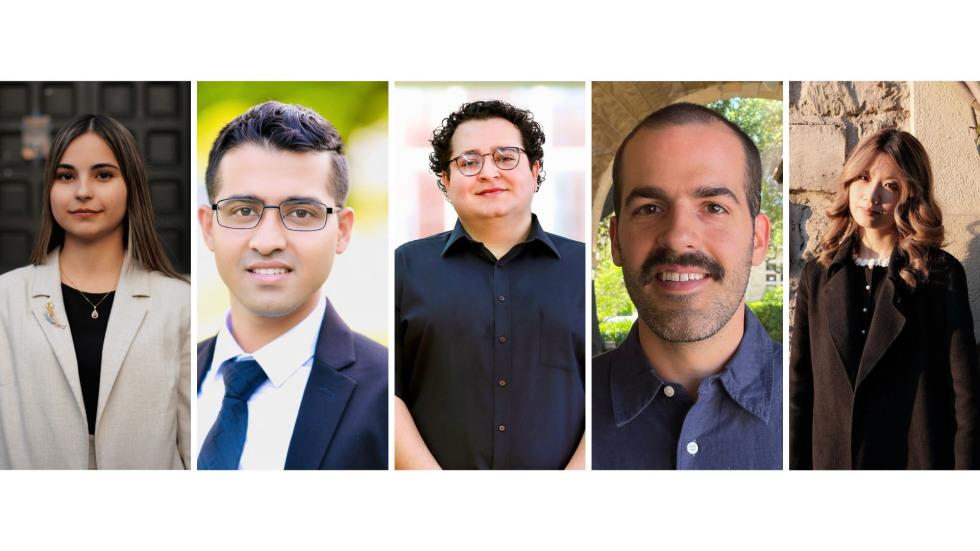
We are pleased to announce the 2026 Summer Research Fellows for the Center for Human Rights and Humanitarian Studies (CHRHS). These researchers will spend their summers working on their respective projects over a period of 4-12 weeks and will present their findings this September at our Fall research symposium. This year's cohort represents a diverse range of disciplines and research interests, all dedicated to advancing our understanding of critical human rights and humanitarian challenges globally.
Olha Burdeina
Olha Burdeina is a rising senior at Brown University double-concentrating in International and Public Affairs and Political Science. Originally from Ukraine, her academic work centers on security studies, veterans' rights, and post-conflict governance. As a Projects for Peace Fellow, she founded REborn, a $10,000 Davis Foundation-funded initiative providing support to veterans and internally displaced persons in Western Ukraine. This summer, she will join the Council on Foreign Relations as a Russian Studies Research Intern and Civitta as a Junior Public Sector Consultant. Her broader policy and advocacy experience spans the Ukrainian Ministry of Foreign Affairs, Razom for Ukraine, and the Parliamentary Assembly of the Council of Europe. On campus, Olha serves as President of the Brown Alliance for Ukraine, Immigration Caucus Director for Brown College Democrats, and a staff writer at the Brown Undergraduate Law Review.
Project Abstract: Governing Veterans' Rights Under War: Decentralization, Martial Law, and Service Delivery in Ukraine
Ukraine's war has produced over 1.2 million registered veterans, yet public confidence in the state's fulfillment of its obligations toward them remains critically low. This research examines how Ukraine's decentralized governance framework shapes the realization of veterans' economic and social rights under wartime conditions. Decentralization distributed service-delivery authority across hromadas and oblasts, but martial law has diluted local self-government with military administrations, generating hybrid accountability arrangements that risk deepening regional disparities. Drawing on legal analysis of Ukrainian legislation, regional policy documents, and secondary sources, this research asks how decentralization interacts with the demands of wartime governance to either expand or constrain veterans' rights in practice. Using a comparative qualitative design, fieldwork across three oblasts—Lviv, Kyiv, and Kharkiv—maps responsibility allocations, state–civil society coordination, and service pathway gaps through document analysis and semi-structured interviews. Findings will be disseminated as a policy brief to Ukraine's Ministry for Veterans Affairs and a peer-reviewed article.
Lila Chamlagai
Lila K. Chamlagai is a PhD candidate in Behavioral and Social Health Sciences at the Brown University School of Public Health. His research focuses on mental health disparities among refugee populations, with a particular emphasis on Bhutanese refugees in Nepal and the United States. Using community-based participatory research (CBPR) approaches, he examines the prevalence and determinants of stress, anxiety, depression, and suicidal ideation to inform culturally responsive interventions. Lila is a "Bill & Melinda Gates Foundation Scholar" and the Founder and President of "Helping Hands: Health and Human Services America" (HH-A), a non-profit organization dedicated to reducing health disparities and improving access to care among underserved and immigrant communities. Born and raised in Bhutanese refugee camps in Nepal, Lila brings lived experience to his academic and community work, interested in strengthening his commitment to advancing health equity, mental health awareness, and sustainable interventions in low-resource settings.
Project Abstract: Investigation of the Prevalence of Anxiety and Depression among Bhutanese Refugees And their Association with Sociodemographic Characteristics: Quantitative Cross-Sectional Survey
This study will estimate the prevalence of anxiety and depression among Bhutanese refugees living in the Beldangi and Pathri Sanischare refugee camps in Eastern Nepal. The study will also examine how these mental health outcomes are associated with sociodemographic characteristics such as age, gender, marital status, education, employment status, religion, caste or ethnicity, camp location, and length of time living in the camps. Refugee populations often experience high levels of mental health problems because they are exposed to trauma, forced displacement, poverty, and long periods of uncertainty about their future. Using a cross-sectional epidemiologic design, researchers will select participants through simple random sampling using official camp registration lists. Trained Nepali-speaking research assistants will collect data using tablet-based surveys. The study will measure anxiety symptoms using the Beck Anxiety Inventory (BAI) and depressive symptoms using the Beck Depression Inventory (BDI). Findings will provide updated evidence that can help humanitarian organizations and policymakers design culturally appropriate mental health screening programs and improve mental health services for Bhutanese refugees living in eastern Nepal.
Mustapha Kharbouch
Mustapha Kharbouch is a junior studying Socio-cultural Anthropology and International & Public Affairs (Development). They have worked at the Center for Middle East Studies and the Global Brown Center for International Students since their freshman year. They are also a research assistant for Dr. Beshara Doumani in the History department and for Dr. Paja Faudree in the Anthropology department. They serve as a returning Minority Peer Counselor (MPC) under the Brown Center for Students of Color (BCSC) and a Meiklejohn. Mustapha is highly moved by questions of indigeneity, justice, and social movements, particularly at the intersection of queer studies and Palestinian studies.
Project Abstract: Queering the Camp: Storyweaving Oral Histories and Futurities of Queer Palestinian Refugees
Palestinians continue to be born stateless in refugee camps in Lebanon, three generations after the 1948 Nakba. They are barred from citizenship, homeownership, voting, or the ability to be a member of a syndicated job, in addition to other basic rights. Already racialized, classed, and gendered, many confront queerness as another experience of otherness. Through conducting interviews with (queer) Palestinian refugees in Lebanon and facilitating a storyweaving community-building gathering, this research hopes to examine the home-making, hope-making, and world-making practices of queer Palestinian refugees when their existence as Palestinian is rejected in queer circles and their existence as queer is rejected in Palestinian circles. This project seeks to cultivate a safe space for queer Palestinian refugees to embrace their unique lived experiences and imagined futures as a revolutionary means of queer indigenous resistance against settler-colonial and ethnoheteronormative state and societal structures.
Esteban Salmón
Esteban Salmón is a Postdoctoral Research Associate at the Watson School for International and Public Affairs. He is a sociocultural anthropologist whose research weaves anthropology, political theory, and legal studies to examine how state authorities and populations in urban Latin America navigate the practical dilemmas of liberal democracy within criminal justice institutions. His work centers on the legal and ethical justifications for state violence in the urban margins of Mexico City.
Project Abstract: Managing Growth in Violent Settings: Corporate Risk-Management in the Mexican Retail Sector
Despite intense criminal violence over the past two decades, Mexico’s economy has remained unexpectedly stable, enabling rapid corporate growth, particularly in the retail sector, which is acutely affected by crime. How do corporations continue to grow amid intense violence? Drawing on interviews with risk-management experts, this project examines how Mexican retail corporations manage crime-related business risks to sustain growth in violent settings.
Anjie Wang
Anjie Wang is a first-year History PhD student who focuses on seventeenth to nineteenth-century Early America. Broadly interested in legal history and empires, she plans to investigate treaty-making, land dispossession, and Indigenous-settler diplomatic relationships in her dissertation. Before starting at Brown, she received her Bachelor of Arts with honors in History and Philosophy, Politics, and Economics from the University of Pennsylvania.
Project Abstract: Failed Promises of Protection: Pennsylvania Treaty Rhetoric and the Formation of Humanitarian Networks in the British-American World, 1682-1837
This project investigates how British colonial and early American authorities framed treaty-making as acts of protection and how these rhetorical frameworks contributed to the emergence of organized Indigenous rights activism in the nineteenth century. Focusing on Pennsylvania, the paper navigates the paradox of humanitarian treaty language that recognizes sovereignty and land rights and the legitimization of dispossession. By tracing Native-settler treaties across the century, it reveals how the promises encoded in diplomatic texts created expectations that were ultimately unfulfilled.