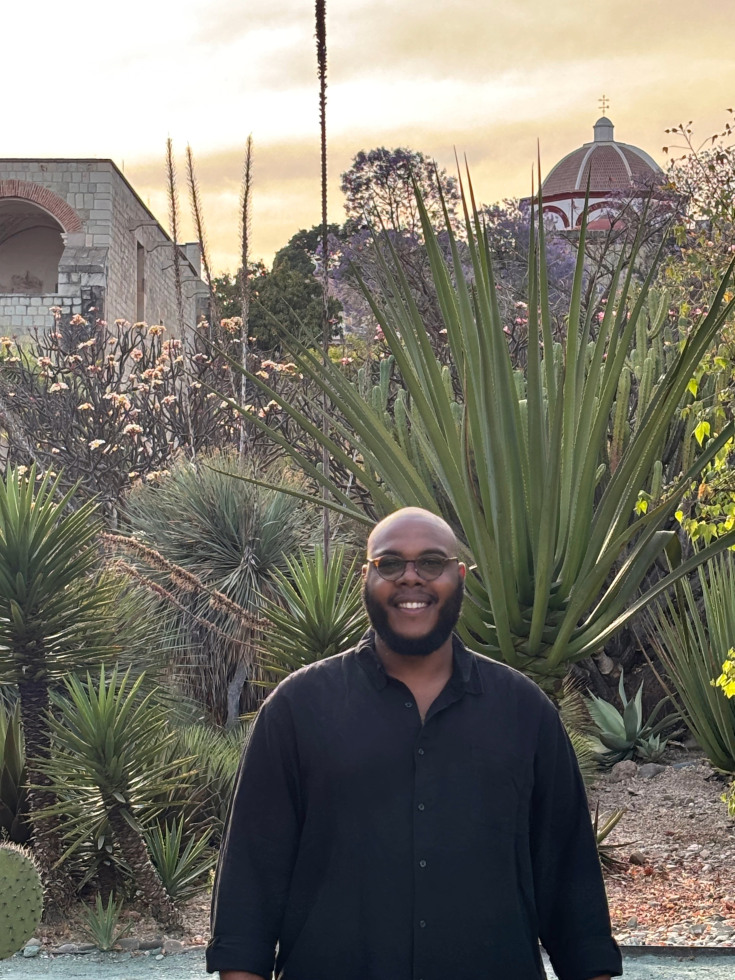
What led you to pursue a PhD in Sociology, and how would you define your primary research interests?
I knew I wanted to be a social scientist in high school and have always dreamed of pursuing doctoral studies. I was fascinated by how human beings organize their lives around invisible structures. Why do we invent rules about what we can eat, whom we may love, where we can and cannot move, or what counts as family? I began my undergraduate studies in Economics, but while studying abroad I discovered Sociology and immediately fell in love with it, as it gave me the tools to pursue those questions. I went on to pursue these studies at the only Dominican university offering the program. During my undergraduate and graduate studies, I explored other disciplines such as Philosophy, History, Geography, and Anthropology; these still shape my scholarship and permit me to produce more interdisciplinary work. However, sociology has remained my intellectual home: a place I can wander into other disciplines and always return to. Its breadth and range of methods and ways of knowing let me approach problems from many angles. My sociological training has helped me focus my research on international migration and borders and their intersections with public policy, socioeconomic development, and ethnic-racial dynamics in the Caribbean. Advancing academic knowledge in this area and translating it into applied research that improves migration and border governance in the region is my north star for my doctoral education.
What were your personal and professional experiences like before coming to Brown, and how have they shaped the way you approach social science research?
Studying sociology in the relatively isolated Dominican context, I sought to broaden my horizons by encountering other realities. I had the privilege of studying in various national contexts, which gave me a strong intercultural perspective. Living and learning alongside people from diverse backgrounds taught me that the richness and complexity of the social world extend far beyond what academic texts can capture: it is not enough to read about people; one has to get close to their realities. These experiences also convinced me that diverse ways of knowing and being are sine qua non conditions for good scholarship. They also shaped my scholarly praxis to focus not only on understanding the world but also on transforming it. My professional work then let me approach migration both from below, alongside migrant communities, and from above, in decision-making spaces. I first worked with Haitian communities in the Dominican Republic’s rural sugar-producing regions, managing education and community development programs that showed me firsthand their material living conditions and the symbolic universe they build from them. I later worked on migration governance within state institutions through applied research, advising, and policy work, where I saw how state power shapes migrants’ lives. Meanwhile, teaching and academic research gave me space to reflect critically on what I observed across these settings. Together, these experiences grounded my work in a commitment to critical sociological scholarship that seeks not only to understand the world but to transform it, improving the lives of the people and communities my research engages.
Tell us a little bit about your research and internship experience in the Dominican Republic this summer. What about it did you find most interesting or impactful?
My current research project explores how Dominican young adults imagine their futures amid developmental transformations, and how mobility fits into them. In recent decades, the Dominican Republic has made notable development progress, including wider access to higher education and complexification of labor markets, yet emigration rates and intentions remain high. Among young adults, arguably the generation that has benefited most from developmental gains, surveys show diverging mobility prospects with no clear demographic pattern. So I ask: why does development make some young people more eager to leave and others more willing to stay? Rather than starting from demographic categories, I spent the summer in the Dominican Republic surveying and interviewing university students about their lives and plans. I am finding that the professionalization path that guided their previous generation–i. e. earning a degree and moving into a stable professional job–no longer guarantees a successful adulthood transition or upward mobility. Moreover, cosmopolitan lifestyles and alternative routes to professional fulfillment are gaining ground, and young people engage with these traditional pathways in disparate ways as they build their lives. For some, emigration offers a way to reach their goals; others pursue them locally by staying immobile; and a growing number imagine transnational lives that move between countries. Thus, I propose to seek answers in the ways in which Dominican young adults co-construct life/professional projects and mobility prospects within the context of developmental change.
At its heart, this is a human rights question: what complexities arise as a development expands capacity to guarantee fundamental rights such as education, decent work, and the freedom to build a life of one’s own? With CHRHS support, I explored that question from another angle by joining TECHO Caribe's Social Research team. TECHO is a youth-led organization working across Latin America and the Caribbean that mobilizes volunteers and communities to confront poverty and sociopolitical exclusion in informal settlements. It treats the guarantee of human rights as intrinsic to development, strengthening communities’ capacity to build collective solutions in the face of rights violations, structural precarity, and disasters. While my dissertation focuses on educated young people who have benefited most from development, TECHO took me to communities that development has reached only partially. Collecting data with their team, I listened to stories often left out of development narratives and shared this work with other young volunteers. What struck me most was how differently, and often contradictorily, people experience development. We tend to narrate development as the work of the state, yet for those on the margins of citizenship, it is also built through community resilience. I came away with another vision of development: one built from the bottom up, often with limited support from the institutions meant to drive it, and sometimes outside official policy agendas. Above all, I returned more convinced than ever that development can be just and sustainable only when grounded in people’s dignity and in the recognition and guarantee of rights for all.
Do you have any advice for other students interested in pursuing research related to human migration?
Official narratives often render certain stories invisible–usually those of subordinate subjects–, replacing the complexity and contradictions of reality with simple, linear accounts. This is especially true of migration. My advice is to look beyond the obvious and be skeptical of mainstream discourse, whether it comes from institutions of power, is amplified by the media, or is repeated in public debate and even in dominant scholarly spaces. I don’t mean that one should always oppose those in power, but that one should never take anything for granted; some of the most important discoveries in the social sciences come from questioning common sense. Go and see for yourself, and talk to people in person. Put faces to the numbers, and don’t ignore the stories behind the data. Above all, I hope we can move away from detached, extractive ways of producing knowledge to embrace a praxis of social transformation. As sociologist Immanuel Wallerstein wrote, “[T]o the extent that we each analyze our social prisons, we liberate ourselves from their constraints to the extent that we can be liberated.” I share that conviction. I believe in the transformative power of science. I hope that, as engaged migration scholars, we commit not only to understanding migrants’ realities but also to transforming them for the better.